






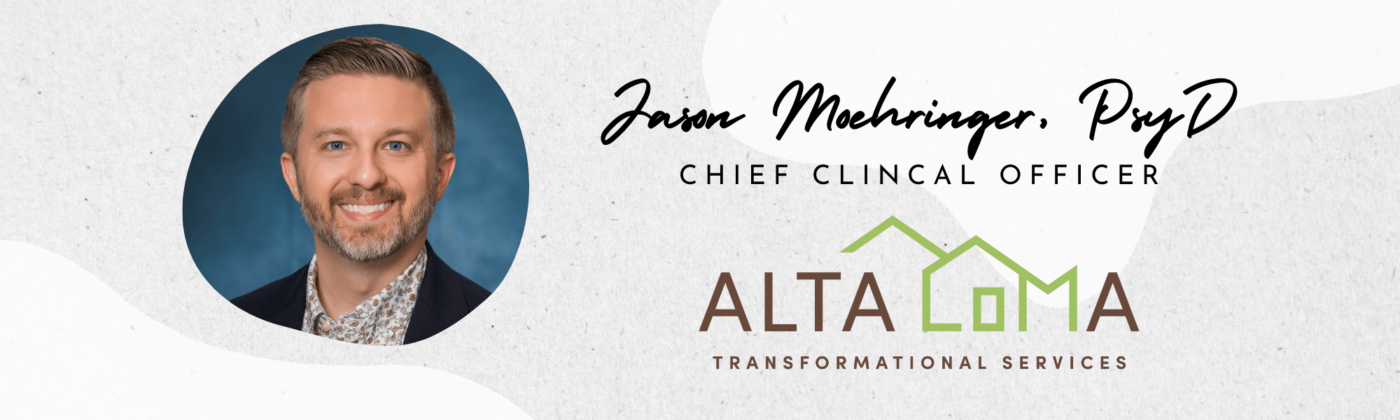
Clinical leadership plays a critical role in every behavioral healthcare organization, setting the
standard for the quality and pace of client care. At Alta Loma, we are proud to have Jason
Moehringer, Psy.D. serving as our Chief Clinical Officer. Missy Distel our VP of Outreach
recently had the opportunity to sit down with Dr. Moehringer to learn more his expertise, vision,
and dedication to advancing care. Join us as we get to know the CCO.
Why did you join Alta Loma?
I have spent my career working with individuals with severe mental health issues and I have
always loved the work. After spending almost 6 years as clinical director of a small program in
Maryland, I joined the team at Alta Loma to take on a bigger challenge and use my skills to help
a wider variety of clients.
What is your experience?
I did my graduate training at The George Washington University and received my doctorate in
psychology. I also did postdoctoral training in inpatient psychiatric hospital work and forensic
evaluations. I am a licensed psychologist in Texas and Maryland. I have supervised students
and led clinical teams for the past ten years.
What’s your why in this work?
When I started my training to become a psychologist, it was still expected that people would
keep their mental health challenges secret. It has been gratifying to see that culture change in
the past few years. Everyone should be able to get the healthcare they need, but I have always
wanted to help the folks who have the most difficult time getting quality mental healthcare, which
is what drew me toward working with people living with severe mental illness. I also find the
intensity of the work rewarding and the clinical challenges interesting. I transitioned into
leadership because I love teaching students, and I feel like my impact on the world is increased
when I can improve healthcare systems and help others be better clinicians.
Ultimately, my clients are role models for me. They must work harder to achieve things that
appear simple or basic to others, and I remind them every chance I get that they should feel
proud of even the most seemingly trivial accomplishment because of how much they had to
overcome to reach it. No matter how difficult things may get in my own life, I can always look to
them for inspiration to keep working hard and stay committed to my goals.
What supervision/clinical oversight do you have with the staff?
Alta Loma has provided me with many tools and resources to make sure our team is doing
exceptional clinical work with our clients. I supervise five teams – clinical services for both of our
programs, behavior services, family services, and health and wellness services. Each team
leader and I meet regularly, and we also have regular clinical leadership meetings so that we all
remain coordinated in the way we take care of our clients. I strongly believe that consistent,
evidenced-based practices help teams and their clients thrive, and I am often working on
policies and procedures to ensure that everyone in our system knows what to expect from each
other. Predictability creates the space for safety and trust, which are the prerequisites for
progress in recovery.
Do clients participate in their treatment plan?
Absolutely! This is a core component of evidenced-based practice in our field, and we have
tailored our approach to collaborative care to meet the needs of clients at each level of our care
continuum. Clients at the beginning of our recovery journey often have more challenges with
communication, memory, and clear thinking, and so collaborative care planning is focused on
building trust and realizing small gains so that clients can achieve real stability. As clients move
into less intensive levels of care, they take on a bigger role in setting treatment goals and
implementing what they have learned in treatment in real-world settings. By the time clients are
planning to graduate from our program, they are the primary creators of their discharge plan and
have resumed responsibility for their daily lives with minimal support.
How do you address non-compliance in treatment?
Most of our clients either deny that they are living with a mental health condition or are unaware
of how it impacts their own and their family’s lives. As a result, many of our clients feel forced to
come to treatment and start off with a negative outlook toward treatment. In our experience,
treatment resistance is typically an expression of fear of and frustration with their circumstances
that is distorted and transformed by the symptoms of the mental illness the person is living with.
We work directly with families during and after the admissions process to set and hold healthy
boundaries that encourage clients to stay in treatment, and we engage with clients to identify
short-term wins that build momentum toward the feeling that treatment is helpful and beneficial.
When we can achieve both of those objectives, clients almost always stay in treatment.
How do you measure success/progress for each client?
This is individualized for each client but generally involves the client achieving the greatest
possible degree of independent living. We encourage each client to think deeply about what
they want out of their life and work to help them attain as much of that as possible. When
necessary, we also help client process their grief and shame around their mental illness so they
can adjust their goals and aspirations to fit their strengths and abilities.
What’s your approach to psychiatric crisis/escalations?
Clients escalate when they feel unsafe, and our efforts at de-escalation are focused on
reestablishing safety. This typically relies on building strong relationships with our clients so that
they know they can rely on us when they are in crisis. Each situation requires different
interventions: in some cases, a short conversation or a walk outside is enough to address the
problem; in other cases, medications can be helpful in reducing the impact of psychiatric
symptoms that may be more acute in the moment. When necessary, we also use our
partnerships with local psychiatric hospitals to give clients extra support if they need additional
stabilization.
How is the family ideally involved in treatment?
We want our families to be involved throughout the treatment process. To that end, we have
dedicated clinicians whose full-time job is to work with family members and other external
supports to keep everyone informed and coordinated. We understand that the experience of
severe mental illness is nearly as traumatic for family members as it is for the client, and so our
team has developed a family services program to give families the support they need.